

 0333 444 0070
7 minute read

5 Ways To Help Prevent A Fire Spreading




Olsen Court is an extra care housing scheme in the historic City of Lincoln. Its self-contained apartments are designed to help residents keep living independently.
Fire Industry Specialists were brought in to remove existing non-compliant fire stopping and install new, fully compliant fire stopping throughout the building. The work restored the integrity of the building’s fire compartmentation and brought it back in line with current legislation.
The building stayed fully occupied from start to finish. Our team planned every stage around residents’ daily lives, working safely and considerately with no impact on the people who call Olsen Court home.
Olsen Court was officially opened in 2006 by HRH the Countess of Wessex (now the Duchess of Edinburgh). It provides specially designed, self-contained apartments with shared communal spaces, giving older residents their independence with support close at hand.
In extra care housing, residents may be less mobile and may need more time to reach safety in a fire. Effective compartmentation is therefore essential: it keeps fire and smoke contained so that people outside the affected area stay protected. The fire stopping sealing every service penetration, joint and void is a critical part of that protection.
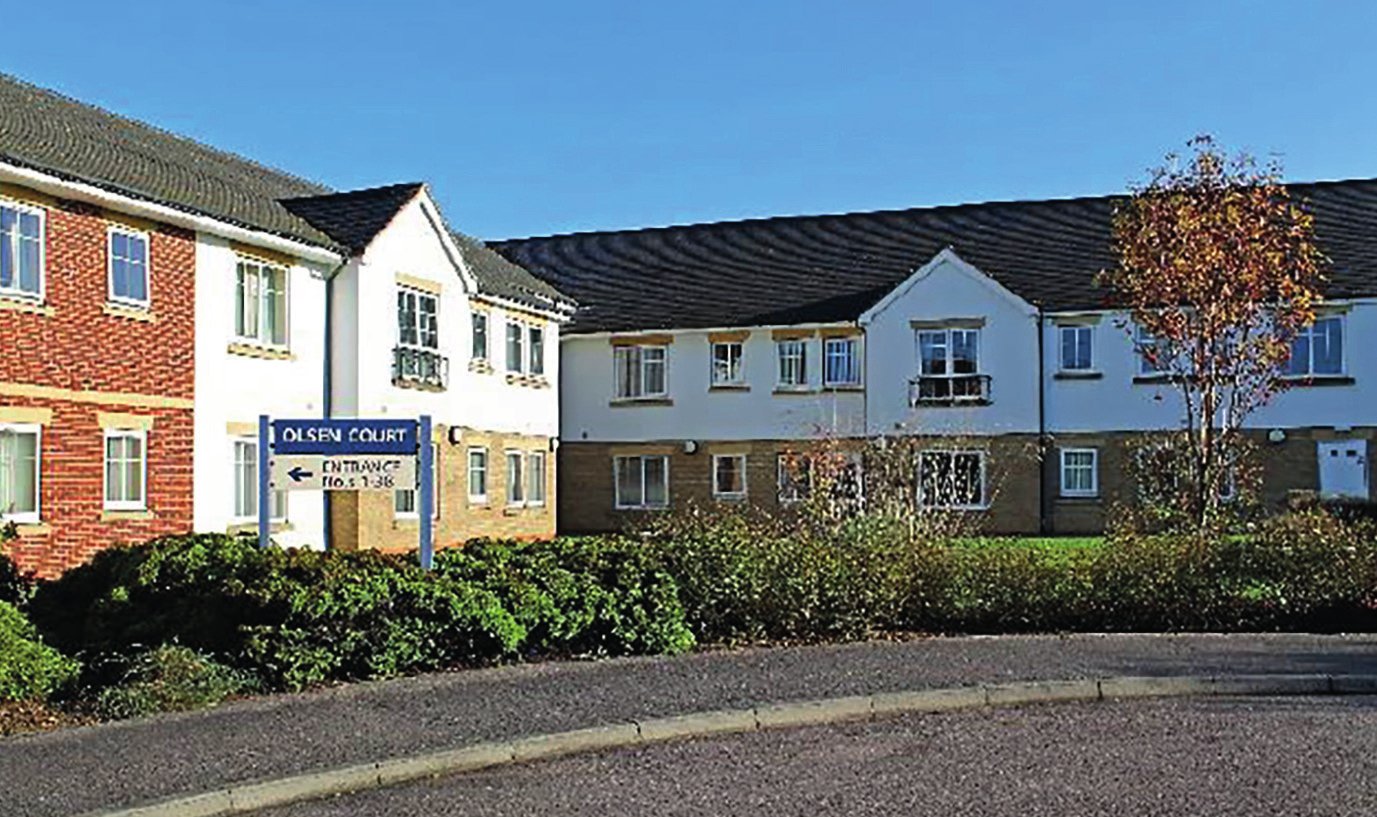
The existing fire stopping at Olsen Court did not meet the standard needed to maintain the building’s compartmentation.
Non-compliant fire stopping is one of the most common issues we find in occupied buildings. It includes:
You can read more about the most common fire stopping mistakes and areas of non-compliance in our guide.
The added challenge was that residents lived in the building throughout. Any solution had to be delivered without disrupting their routines, compromising their safety or leaving areas unprotected overnight.
We worked closely with the client and the on-site team to plan the programme in phases. Work areas were scheduled to minimise noise and access restrictions, and residents were kept informed about when work would take place near their apartments.
The existing non-compliant fire stopping was carefully removed from service penetrations, risers and junctions. This exposed the true condition of each opening so it could be sealed correctly.
We reinstated the fire stopping using the full suite of Rockwool products. A single-manufacturer system gives a proven, tested solution for each type of penetration, rather than a mix of products that may not perform together.
Completed fire stopping was labelled for identification. This gives the client clear evidence for their fire risk assessment and future maintenance.
Working in a residents’ home demands a different approach from a construction site. On this project our team maintained:
Olsen Court now has compliant, consistently installed fire stopping throughout the building. Its compartmentation can again do its job of containing fire and smoke. The work was completed on schedule with the building fully occupied, and with no harm to residents or disruption to daily life.
If you manage an occupied building and are worried about the condition of its fire stopping, we can help. FIS carries out fire stopping surveys and remedial works for housing providers, care operators and building owners across Lincoln, Nottingham, Sheffield and the wider UK. We plan every project around the people who live and work in the building.
Fire safety is a responsibility that never rests, and we’re here to deliver complete fire protection for your building. Call us on 0333 444 0070 or fill in our online form.
Fire safety is a responsibility that never rests and we’re here to implement complete fire protection for your business. Get in touch with our industry-leading experts to learn how we prevent fires, protect lives, and ensure compliance for you.








Fire Industry Specialists offer expert fire safety solutions to protect homes and businesses and ensure complete compliance with UK fire safety standards and regulations.