

Fire Stopping for Walls and Floors
Protecting compartmentation across your building.
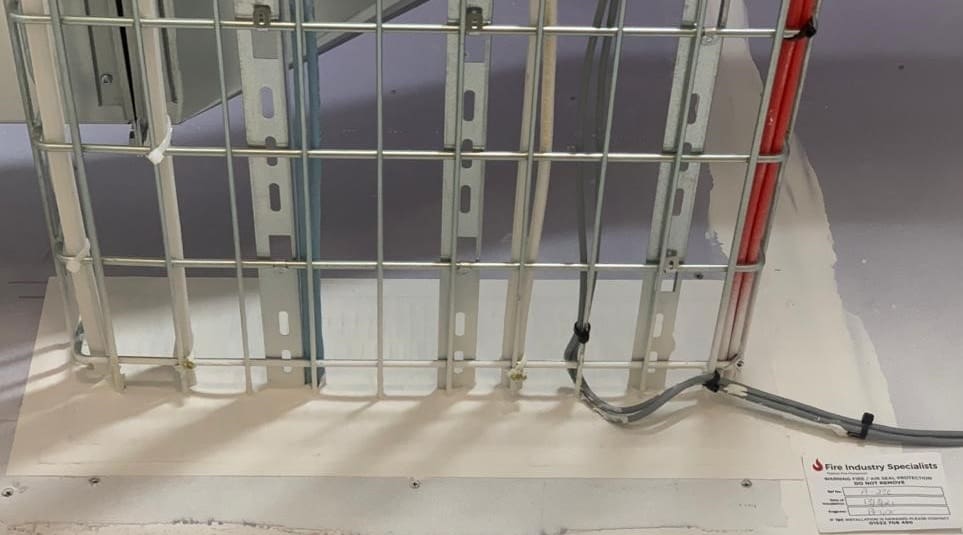
Fire stopping is a vital component of passive fire protection. It involves sealing gaps, joints, voids, and service penetrations within walls and floors to maintain fire compartmentation and prevent the spread of fire and smoke throughout a building. Without proper fire stopping systems in place, even minor breaches can allow fire to spread rapidly between compartments, putting lives, assets, and operations at risk.
At Fire Industry Specialists (FIS) Ltd, we provide fully certified fire stopping services for commercial buildings across the UK. Whether you’re working on a new development or need remedial fire stopping installation, our team offers a compliant, expert-led approach tailored to your site’s layout, occupancy, and risk profile.
What is fire stopping and why is it essential?
Fire stopping refers to the process of filling, sealing, or otherwise treating openings and gaps in fire-rated walls and floors. These gaps are typically caused by pipes, ducts, cables, or structural movement and, if left unsealed, compromise the integrity of fire compartmentation.
A fire stop system helps ensure that a wall or floor retains its fire resistance rating by preventing fire, smoke, and heat from travelling between compartments. In commercial and industrial buildings, this is especially critical, protecting escape routes, minimising asset damage, and ensuring compliance with fire safety legislation.
As stated in Approved Document B of the Building Regulations and BS 476 / BS EN 1366, buildings must be constructed and maintained in a way that restricts the internal spread of fire. Our fire stopping contractors deliver solutions that meet these standards while aligning with your project’s construction phases or remedial timelines.
Fire stopping installation by certified specialists
At FIS Ltd, all of our fire stopping installations are carried out by IFC third-party certified engineers. This certification gives our clients peace of mind that the work has been tested and validated by an independent fire safety body, which is especially important for projects requiring formal sign-off and evidence of compliance.
Whether you’re planning a new build, overseeing a retrofit, or responding to fire risk assessment findings, our fire stopping team will:
- Assess and map out all existing and potential fire-stopping breaches
- Specify the appropriate fire stopping products and materials
- Install solutions to meet fire resistance requirements (typically 30, 60, 90, or 120 minutes)
- Provide full documentation and photos for each penetration or treated area
We also work closely with building managers, contractors, and compliance officers to ensure all work integrates with ongoing fire safety strategies or wider passive fire protection systems.
Maintaining and inspecting fire stops over time
Once your fire stopping installation is complete, maintaining its integrity is just as important as the initial installation. In commercial and industrial environments, buildings are subject to frequent changes; new cabling, pipe rerouting, HVAC alterations, and structural adjustments can all breach compartmentation.
That’s why routine inspections are a vital part of passive fire protection. We recommend that fire stops in walls and floors be inspected at regular intervals, especially following any refurbishment, service installation, or remedial works. These inspections should be carried out by qualified professionals with knowledge of fire stop systems, relevant materials, and resistance ratings.
At FIS Ltd, we can provide ongoing fire stopping surveys, either as a standalone service or as part of a broader passive fire protection programme. Our engineers use detailed reporting tools, including photo evidence and schematic mapping, to give building managers full visibility of existing protection and areas requiring improvement.
By proactively maintaining your fire stopping systems, you’ll ensure compliance with BS 9999 and Approved Document B, while reducing risk across your premises.
Fire stopping products and materials we use
Fire-rated sealants
Used to seal linear joints and service penetrations in walls and floors, these can include acrylic, silicone, or graphite-based sealants with flexible and intumescent properties.
Ablative coated batts
High-density mineral wool batts coated with fire-resistant ablative material. They’re ideal for sealing voids around service penetrations in drywall, masonry, or concrete walls and floors.
Fire collars and wraps
Designed to expand under heat, these are used around plastic pipework to seal off openings during a fire and are available in various sizes and resistance ratings.
Fire compounds
High-strength cementitious materials are typically used for sealing large or load-bearing openings in floors where foot traffic is expected.
Fire sleeves and pillows
Flexible or removable fire-stopping components are used for temporary or adjustable solutions during installation or maintenance phases.
All fire stopping materials we use are tested to BS EN 1366 and BS 476 standards and come with manufacturer performance data and fire resistance ratings.
Our local and national fire stopping services
With offices in the East Midlands and operational hubs throughout the country, we’re well-positioned to deliver fire stopping in the East Midlands and across the wider UK. Our association with the LS Fire Group ensures we can handle both regional and national-scale commercial projects without compromising on quality, responsiveness, or compliance.
Whether you’re a principal contractor, property owner, facilities manager, or fire safety consultant, we can support your fire safety strategy with trusted fire stopping expertise.
Why choose FIS Ltd as your fire stopping contractor?
- IFC-certified fire stopping installers
- Full documentation, mapping, and installation records
- Trusted by commercial clients across construction, education, healthcare, and industrial sectors
- Rapid mobilisation for remedial works or new developments
- Backed by the LS Fire Group, offering national coverage with local presence
Get in touch with our fire stopping specialists today
If you’re responsible for fire safety in a commercial building, don’t leave compartmentation to chance. At FIS Ltd, we’re one of the UK’s most trusted fire stopping companies, delivering compliant, cost-effective solutions tailored to your premises.
For fire stopping in the UK, contact us today to speak with our team or request a quote. We’ll help ensure your building meets fire safety regulations, and keep people and assets protected in the event of a fire.
Our other services
Fire safety is a responsibility that never rests and we’re here to implement complete fire protection for your business. Get in touch with our industry-leading experts to learn how we prevent fires, protect lives, and ensure compliance for you.

Fire Stopping FAQs
- What is fire stopping and why is it essential in walls and floors?
- Fire stopping is a critical part of passive fire protection. It involves sealing any gaps, penetrations, or joints in fire-resisting walls and floors to prevent the spread of fire, smoke, and toxic gases. Without proper fire stopping, these areas can become weak points, allowing flames to travel unchecked between compartments of a building. In the UK, fire stopping is a legal requirement under the Regulatory Reform (Fire Safety) Order 2005, especially in multi-occupancy or high-risk buildings. When correctly installed, fire stops help maintain the building’s compartmentation and slow the spread of fire, giving occupants more time to evacuate safely. At FIS, our experienced team carries out compliant fire stopping installations across Nottingham, Lincoln, and throughout the UK, ensuring your building is protected and your legal obligations are met.
- What types of fire stopping products are used for walls and floors?
- Fire stopping products vary depending on the type of wall or floor and the materials passing through it. Common solutions include intumescent sealants that expand with heat to seal joints, fire batts and boards for larger voids, pipe collars and wraps for service penetrations, fire stop mortars to fill irregular gaps, and cavity barriers for concealed spaces. Each product must be properly selected and installed to maintain the fire rating of the wall or floor it is protecting. The wrong product or an incorrect installation can compromise the safety of the entire compartment. If you’re unsure which fire stopping products your building needs, FIS provides expert advice and specification on fire stopping systems, with full installation and certification across commercial and public sector buildings.
- What’s involved in professional fire stopping installation?
- A quality fire stopping installation follows a defined process. First, the site is surveyed to locate and assess all penetrations and voids. Next, compliant systems are specified for each area, tailored to the building’s fire rating requirements. Surfaces are then prepared and materials applied according to manufacturer and tested details. Finally, all works are inspected and certified to confirm compliance. Whether you’re working on a new build or upgrading an existing property, engaging a qualified contractor is essential to ensure all works meet fire safety regulations and industry best practice. At FIS, we provide end-to-end fire stopping services, from survey and design to installation and digital record-keeping. Our accredited engineers operate throughout the UK, including all major cities.
- What’s the difference between fire stopping and fire stops?
- The term fire stopping refers to the overall process of protecting a building’s walls and floors from fire spread. This includes identifying risk areas, selecting the right systems, and carrying out the installation. By contrast, fire stops are the physical materials used in this process, such as collars, sealants, wraps, and batts, that block or slow the spread of fire and smoke. In short, fire stopping is the strategy, and fire stops are the tools used to implement it. Both are essential in achieving fire compartmentation and maintaining building safety. If you’re looking for a reliable team to manage your fire stopping requirements, FIS offers complete fire stopping solutions, including the supply and installation of fire stops for walls and floors, fully certified and documented.
- Do you offer fire stopping services in Nottingham and Lincoln?
- Yes, we do. Fire Industry Specialists Ltd provides fire stopping services nationwide. Whether you’re managing a commercial building, healthcare facility, school, or residential development, our team will assess, install, and certify your fire stopping systems in full compliance with UK legislation. Need fire stopping in the UK? With our nationwide coverage, Contact FIS today to schedule a site survey or request a quote.
- How do fire stopping systems contribute to overall compartmentation in commercial buildings?
- Fire stopping systems are a critical part of compartmentation, which is the process of dividing a building into distinct fire-resistant sections. In commercial buildings, this strategy helps contain fire and smoke to a single area for a set period – typically 30 to 120 minutes – to allow for safe evacuation and reduce structural damage. Fire stopping products are used to seal service penetrations and joints in walls and floors that would otherwise allow fire to spread. Without proper fire stopping, even a small gap can render compartmentation ineffective, putting lives and compliance at risk.
- What are the most common causes of failed fire stopping in walls and floors?
- The most common issues arise when fire stops are disturbed or removed during electrical, plumbing, or mechanical works and are not reinstated correctly. Over time, services may be upgraded, replaced, or rerouted, leaving openings in compartment walls or floors. Other causes include the use of non-compliant materials, poorly installed fire stopping products, or expired intumescent materials that have degraded. At FIS Ltd, we offer ongoing inspections and fire stopping surveys to help identify and correct these issues, particularly in high-traffic commercial and industrial environments.
- Can fire stopping products be retrofitted in older buildings or only installed during construction?
- Fire stopping can absolutely be retrofitted in older buildings. In fact, many commercial clients in heritage or mixed-use properties come to us needing remedial fire stopping work to bring their buildings in line with current UK regulations. Our team can assess the existing structure, identify any breaches or gaps, and recommend suitable fire stopping installation methods, whether that’s coated batts, sealants, collars, wraps, or fire compound. Retrofitting requires careful consideration of existing materials and access constraints, which is why it’s best handled by experienced fire stopping contractors like us.
- What should building managers look for when choosing a fire stopping company?
- Building managers should ensure the fire stopping company is third-party certified, ideally through schemes like IFC Certification, which we hold. The company should have a strong track record in commercial or industrial fire stopping installation, use compliant fire stopping materials tested to BS EN 1366 or BS 476, and be able to provide documentation such as installation records and certification. It’s also important that they understand fire strategy integration, particularly for walls and floors within complex premises like hospitals, schools, or office buildings.
- How often should fire stopping systems in walls and floors be inspected or maintained?
- Fire stopping systems should be inspected whenever there are alterations to services, refurbishments, or after any work that might compromise compartmentation. At a minimum, annual fire risk assessments should include a review of all fire stopping measures. In commercial buildings where regular maintenance or tenant changes occur, more frequent inspections may be needed. We can provide detailed fire stopping surveys and ongoing maintenance services across Nottingham, Lincoln, and throughout the UK to ensure your fire protection measures remain effective and compliant.